Showing posts with label sewing stitch. Show all posts

Thursday, January 1, 2015

Sewing Stitch Types


Dear All,


Though you will get more than 100 posts regarding sewing stitch on the web, however, I am again posting here the some sewing stitch photo with details. 
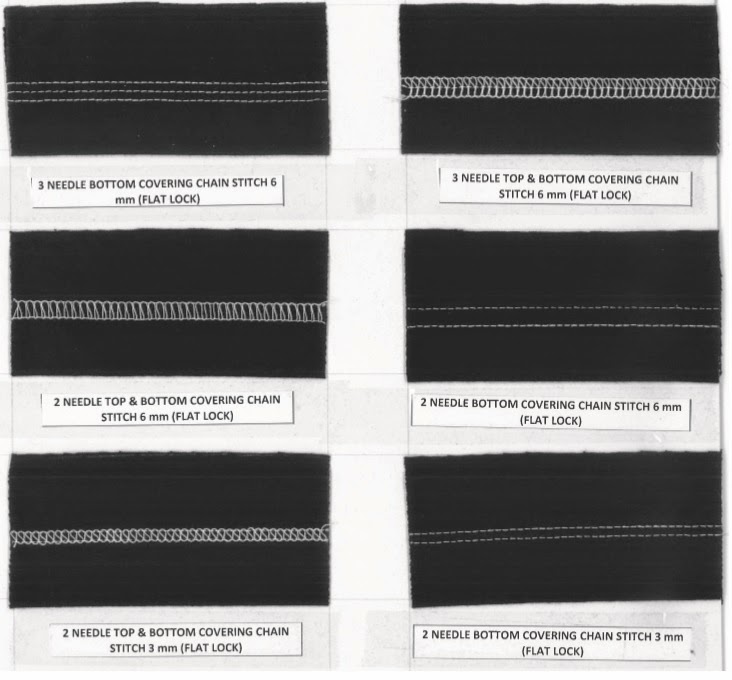

A.    3 Needle Bottom covering chain stitch, 6 mm (Flat Lock)

B.    3 Needle Top and Bottom covering chain stitch, 6 mm (Flat Lock)

C.     2 Needle Top and Bottom covering chain stitch, 6 mm (Flat Lock)

D.    2 Needle Bottom covering chain stitch, 6 mm (Flat Lock)

E.     2 Needle Top and Bottom covering chain stitch, 3 mm (Flat Lock)

F.     2 Needle Bottom covering chain stitch, 3 mm (Flat Lock)


G.    Multi thread single needle chain stitch (Front View)

H.    Multi thread single needle chain stitch (Back View)


I.     Over lock 4 threads stitch, 7 mm

J.     Over lock 3 threads stitch, 5 mm

K.    Over lock 3 threads stitch, 2 mm  

L.     Over lock 3 threads stitch, 3 mm

M.    Blind / Base Ball Stitch, 2 mm

N.    Blind / Base Ball Stitch, 3 mm 


O.    3  Thread over lock stitch (Latus)

P.     Plain Stitch / lock Stitch


Sorry for the poor image quality. 


----------------------------------
Thanks & Best Regards

Enamul Haque Bipul
Skype: bipul1984
Mob: +8801717264756


.

Monday, March 26, 2012

Stitches & Seams Analysis (Part 01)

Presented by : Mr. Mukesh Halari. 

 Apparel Manufacturing

By S. H. Shin, Ph.D.


Stitches & Seams Analysis


Objectives:

1. Define stitch classifications, characteristics, and formation.

2. Identify seam classification, types, and uses.

3. Relate the properties of stitches and seams to production costs, performance, and quality.

4. Examine functions, characteristics, and selection of sewing threads and needles.

5. Examine the relationship between needles, thread, and fabric.

6. Analysis seam appearance and performance.


Stitches and Seams


Standards that defined stitches and seams:

1. The United States Federal Stitch and Seam Specification (Federal Standard 751a) in 1965.

2. ASTM D 6193, Standard Related to Stitches and Seams


Definitions

1. A Stitch: is the configuration of the interlacing of sewing thread in a specific repeated unit.

2. A Seam: is a line where two or more fabrics are joined.

3. A Stitching: consists of a series of stitches embodied in a material for decorative purpose or finishing an edge.


Stitches


Stitch classification is based on:
1. Structure of the stitch

2. Method of interlacing stitch properties.


Stitch properties:

1. Relate to aesthetics and performance


o Stitch size

§ Stitch length, width, and depth.

o Thread tension

o Stitch consistency.


Stitch properties: Stitch size


Stitch Length:


Stitches per inch (spi)

1. High spi

o Short stitches: High quality

o Potential problems (seam

o Pucker or weaken fabric).

o Higher spi, the more time and thread, high cost.


2. Low spi

o Long stitches: Lower quality

o Problems: Less durable,

o Snagging, abrasion, grin through

o Fast, less thread, less cost.


Example:

Men’s shirts 22 spi vs. 8 spi


Stitch properties: Stitch size


Stitch Width:

o Distance between the outermost lines of stitches.


o Refers to the horizontal span covered in the formation of one stitch.


o Referred to as gauge, (inch)

§ Example: overedge, zigzag, and cover stitches (1/4 inch)


o Width dimensions require multiple needles or lateral movement of thread carriers:

§ Example: needle bars, lopper’s, or spreaders.


Stitch properties: Stitch size


Depth:

             Distance between the upper and lower surface of the stitch
         
             􀂄 Example: Blind stitches (Curved needle with lateral movement)


To be continue..............................

Sunday, March 11, 2012

Sewing Stitch Description

Description of Different Kinds  Sewing Stitch 


Stitch Name: Single thread blind stitch
ISO Stitching Code number: 103 (Blind Stitch)
Use in process: Blind hem, belt loop etc.

Face View


Back View
(Not visible on back)


Stitch Name: Lock Stitch (it is the most common stitch)
ISO Stitching Code number: 301 (Lock Stitch)
Use in process: Top sin or top stitch, straight stitching, single needle etc.

Face View


Back View (bobbin thread)


Stitch Name: Double needle Lockstitch
ISO Stitching Code number: 301 – 02 (Lock Stitch)
Use in process: Double top stitch

Face View


Back View (bobbin thread)


Stitch Name: Zig Zag Lockstitch
ISO Stitching Code number: 304 (Zig Zag)
Use in process: Sportswear, Athletic wear

Face View


Back View


Stitch Name: Chainstitch
ISO Stitching Code number: 401 (chainstitch)
Use in process: Shoulder to shoulder back tape stitching etc.

Face View


Back View (Looper Thread on bottom)


Stitch Name: 2 needle chainstitch
ISO Stitching Code number: 401 – 02 (chainstitch)
Use in process: 2 needle seam stitching.

Face View


Back View (double looper thread on bottom)


Stitch Name: Two needle cover stitch
ISO Stitching Code number: 406 (Bottom Cover Stitch)
Use in process: Cover seam, Belt loop, Neck Binding,

Face View


Back View (Looper thread)


Stitch Name: Three needle cover stitch
ISO Stitching Code number: 407 (cover stitch)
Use in process: Elastic attaching of boys & men’s under wear

Face View


Back View


Stitch Name: Two thread Overedge
ISO Stitching Code number: 503
Use in process: Blind hem & Serging

Face View


Back View


Stitch Name: Three Thread Overedge
ISO Stitching Code number: 504 (1 needle thread with two looper thread)
Use in process: 01 needle Overedge seaming

Face View


Back View


Regards
Bipul
Related Posts Plugin for WordPress, Blogger...